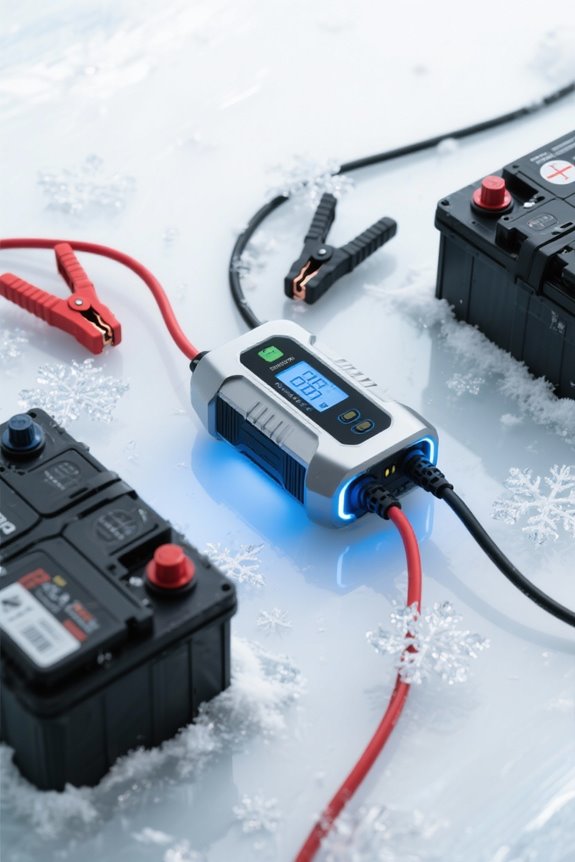


When we pick a jump starter, we need to match it with our vehicle’s needs. First, consider the cranking amps—small cars need 400-600A, while larger SUVs might need 800-1500A. Next, think about battery types; lithium-ion is lighter and more portable. Look for safety features like reverse polarity protection, too. Finally, weigh the price against performance. Don’t worry, we’ll share specific recommendations for different vehicle types soon!
Key Takeaways
- Determine your vehicle’s battery type and required peak amps, considering factors like engine size and whether it’s gas or diesel.
- For compact cars, choose jump starters with 400-800A peak amps; SUVs and midsize sedans should have 800-1500A.
- Opt for models with essential safety features, such as reverse polarity protection and spark-proof connections, to ensure secure operation.
- Regularly maintain your jump starter by checking for moisture and recharging it when the voltage falls below 12.4V for reliability.
- Consider the warranty and customer support offered by the brand, as a good warranty indicates product quality and reliable service.
Understanding Battery Capacity
When it comes to choosing a jump starter, understanding battery capacity is essential. We’ll want to evaluate the battery types available, like lead-acid or lithium-ion, as they affect power and portability. Battery capacity is typically measured in amp-hour ratings, which tell us how much energy a jump starter can hold. For larger vehicles, a higher capacity means more power for reliable starting.
When looking at amp hour ratings, remember: the more amp hours, the more jumps you can get on a single charge. If we’ve got an SUV, for example, a jump starter with at least 12 ah might be ideal for us. Additionally, consider models with peak outputs that align with your vehicle’s requirements to ensure effective jump-starting. Let’s find the right balance between power and features to stay prepared for any situation!
Importance of Cranking Amps

Understanding cranking amps (CA) is essential for selecting the right jump starter for our vehicle. Unlike peak amps, which reflect a brief burst, cranking amps measure sustained power we need to actually turn over the engine. The higher the CA, the more reliable our jump starter will be, especially during those chilly mornings when we need it the most.
As a rule of thumb, smaller vehicles need about 400-600 CA, while larger engines or diesel vehicles may demand 800-1000 CA or more. So, when we’re shopping for a jump starter, let’s focus on CA ratings to guarantee we have enough power for our engines, regardless of their size or our weather conditions. Additionally, keeping in mind the cold cranking amps (CCA) can further ensure optimal performance in colder climates.
Engine Compatibility

To guarantee we’re choosing the right jump starter, it’s essential to know our vehicle’s engine compatibility. For instance, diesel engines generally have higher power demands due to their larger batteries, so we need a jump starter that can deliver sufficient peak and cranking amps. If we’re dealing with gasoline engines, however, we can often use a jump starter with lower current ratings.
For those of us driving heavier vehicles, like trucks, we should pay attention to specific diesel specifications and make sure our chosen jump starter meets those engine requirements. Choosing a model with adjustable voltage is smart, as it makes our jump starter versatile for different vehicles, whether we’re helping a friend or dealing with our own. Additionally, understanding the charging current rating is crucial for ensuring our jump starter can effectively power the vehicle’s engine.
Types of Vehicles and Their Requirements

As we explore the various types of vehicles and their jump starter needs, it’s essential to recognize that different engines have unique demands. For example, passenger cars typically use 12V batteries and require jump starters with 400–600 peak amps for 4-cylinder engines. SUVs and light trucks often need 600–1000 peak amps due to larger engine sizes.
When it comes to heavy trucks, they can demand a whopping 1000–3000 peak amps, typically using 12V or 24V battery systems. Diesel engines require even more strength, often needing 1000+ peak amps. Finally, classic vehicles may use 6V batteries, which means we should check compatibility first. Understanding these vehicle types and their specific requirements will guide us in choosing the right jump starter. Additionally, it’s important to consider the power output capacity of the jump starter to ensure it meets the demands of your vehicle’s engine.
Features to Look for in a Jump Starter

When we’re picking out a jump starter, it helps to know which features will match our needs. Look for high peak amps—ideally between 2,000A to 10,000A—to tackle larger engines. Cold cranking amps (CCA) are essential for cold weather, so having at least 200A is a good starting point.
Safety mechanisms are a must-have. Features like reverse polarity protection prevent damage if clamps are connected incorrectly, and spark-proof connections reduce fire risks. Additionally, having features like high-grade materials ensures the jump starter’s durability and reliability during emergencies.
Having extra functionality, like dual USB outputs for charging devices, makes the jump starter even more useful on the road.
Portability Considerations
Finding the right balance between power and portability can make a big difference in how handy your jump starter is. For those of us who value emergency readiness, portable designs matter. Small, compact options like the NOCO Boost Plus GB40 weigh only 2.0 pounds and fit neatly in glove compartments, making them great storage solutions. However, we must consider weight concerns and feature trade-offs; larger units may offer more power but can weigh nearly 30 pounds. This switch might cater more to professional users than casual ones. When browsing through buying guides, think about how often you’ll need the jump starter. If it’s infrequent, lightweight models are likely the best fit for us all. Additionally, many models offer multiple jump-starts per charge, providing an added layer of convenience during emergency situations.
Design Elements for Ease of Use
How can we make jump-starting our vehicles less stressful? A user-friendly interface is key. Look for jump starters with clear visual indicators, like LED lights that show battery status, ensuring we won’t struggle in bright sunlight or darkness. Color-coded clamps also help—green for positive and red for negative, reducing any chance of error.
Tactile controls make a huge difference, too. Large buttons with good feedback are easy to press, even if we’re wearing gloves. Some models offer one-click operation, simplifying the process even more. Safety features, like spark-proof technology and reverse polarity warnings, give us extra peace of mind. Additionally, consider multi-functional options that enhance convenience, such as integrated air compressors for inflating tires. With these thoughtful design elements, we can tackle jump-starting confidently and easily!
Checking Jump Starter Specifications
Next, consider cold cranking amps (CCA), especially if you live in colder climates. Higher CCA means better performance in chilly weather. Lastly, check the engine compatibility. Many jump starters suit gasoline engines up to 6.5L or smaller diesel engines up to 4L, like the Bolt Power D28A. Matching these specs guarantees you choose a reliable jump starter for your vehicle! Additionally, ensure the jump starter has adequate peak amp rating to match or exceed your vehicle’s engine size for optimal performance.
Charging Times and Maintenance
Maintaining a jump starter isn’t just about having it on hand; it also means knowing how to keep it charged and ready to go. For most of us, charging frequency is key—lithium-ion models recharge quickly, often in about 1.3 to 3 hours. Meanwhile, lead-acid units can take 6 hours or more.
To keep our jump starters in top shape, here are some maintenance tips: recharge every six months, even if we don’t use it. Storing it in a cool, dry place helps, too. We should watch out for extreme temperatures, which can diminish performance. Following these simple guidelines guarantees we won’t be left stranded when we need a jump! Additionally, higher peak current is essential for effective operation in extreme cold, so always check the specifications of your model.
Assessing Battery Life
After confirming our jump starters are well-maintained and charged, it’s time to look at evaluating their battery life. Understanding battery testing methods, like load testing and conductance testing, can help us check how well our jump starters are holding up.
We should keep an eye on factors affecting longevity—temperature, charging cycles, and even mechanical stress can shorten battery life. Regularly measuring the state of charge (SoC) and open circuit voltage confirms our batteries stay healthy. If we see a voltage below 12.4 V, it’s time for a recharge. By paying attention to these signs, we can make certain our jump starters are always ready when we need them most! Additionally, many jump starters also serve as portable power banks for charging devices, which can further enhance their usability and longevity if used wisely.
Price Range and Budget Options
When it comes to choosing a jump starter, price is a big factor we can’t ignore. For those of us on a budget, options typically range from $50 to $80. These budget models, like the Gillway and Yber Auto, provide basic jump-start capabilities but may lack premium features like advanced safety.
If we’re willing to spend a bit more, mid-range options ($100–$150) offer about 2,000 amps peak and additional accessories, making them a solid choice for regular vehicle users. They balance budget benefits and reliability nicely.
On the flip side, premium models over $300 boast powerful performance and longer battery life. Overall, let’s pick a jump starter that meets our needs without breaking the bank!
Value for Different Use Cases
Finding the right jump starter isn’t just about picking the cheapest model; it’s also about matching the device to our specific needs. When we look at value comparisons, we should consider what we truly need. For example, a lightweight model under 5 lbs is great for those of us wanting easy portability for emergencies or travel. If we use it frequently or on larger vehicles, we might prefer a heavier-duty, high-capacity unit, like the Clore JNC770R, ensuring consistent performance across multiple jump starts. Pay attention to user preferences: some need additional features like charging ports or built-in lights. By considering our use cases, we can choose a jump starter that not only meets our expectations but exceeds them reliably.
Warranty and Customer Support
Choosing a jump starter means we should also pay attention to the warranty and customer support. Most respected brands offer warranties of one to two years, so we want to check the warranty conditions before buying. This typically covers defects under normal use, but not damage from misuse.
When it comes to customer service, we should look for brands with responsive support teams. A good company will guide us through warranty claims clearly. Some even have online portals for tracking our claims, which is super helpful.
Recommendations for Specific Vehicle Types
Selecting the right jump starter can feel overwhelming, especially with different vehicle types in mind. For compact cars, we recommend lithium-ion jump starters with peak amps between 400-800A. Brands like the NOCO Boost series are great choices for 4-cylinder engines.
For midsize sedans and SUVs, opting for jump starters that deliver 800-1500A is best. Models from Jackery and NOCO Boost X Series offer a good balance of power and portability.
If you’ve got trucks or larger SUVs, look for heavy-duty options with over 1500A. Clore Automotive provides excellent power for those bigger engines. Finally, don’t forget about motorcycles and ATVs—they need compact options with about 300-600A.
Additional Tips for Jump Starter Use
Have you ever wondered how to safely use a jump starter without causing a scene? Let’s chat about some important safety precautions and emergency procedures. First, we should always wear insulated gloves and goggles to protect ourselves from battery acid and sparks. It’s also smart to remove any jewelry and avoid loose clothing that might touch battery terminals.
Before connecting, double-check the jump starter and vehicle are off. We want to connect the positive clamp first, then the negative, ensuring they don’t touch. If we’re ever unsure, calling a professional is the best option. Finally, keeping electronic devices off and storing our jump starter properly can make our lives a lot easier!
Frequently Asked Questions
Can Jump Starters Be Used to Power Other Devices?
Yes, jump starters can power other devices! With jump starter compatibility and portable power features, we can easily charge our phones and tablets on the go, keeping us connected during emergencies or adventures.
How Often Should I Recharge My Jump Starter?
We think it’s crucial to recharge our jump starter every three months for peak charging. Regular maintenance frequency guarantees it’s always ready, even if we don’t use it often. Let’s keep our devices performing at their best together!
What’s the Shelf Life of a Jump Starter Battery?
The shelf life of a jump starter battery typically ranges from 2–5 years, depending on usage. By following proper maintenance tips—like storing it at the right temperature—we can maximize its lifespan together.
Are Jump Starters Safe for Sensitive Electronic Vehicles?
Yes, jump starters can be safe for sensitive electronic vehicles when we guarantee proper jump starter compatibility. By using certified equipment, we protect our vehicle electronics from damage and maintain peak performance, helping us drive with confidence.
Can I Use a Jump Starter in Extreme Weather Conditions?
Yes, we can use jump starters in extreme weather conditions. In both cold weather and hot weather, choosing models with high CCA and safety features guarantees reliable performance, helping us confidently handle any situation together.